


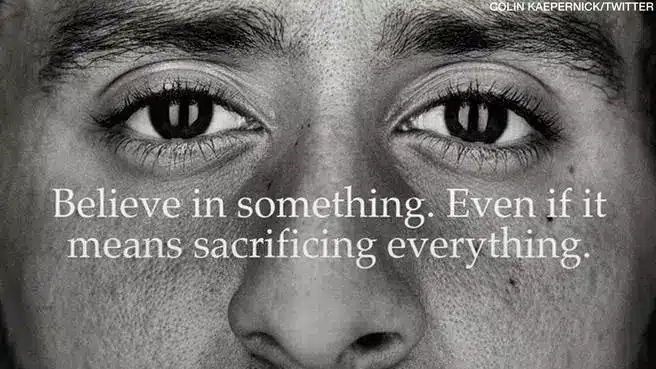
Following the latest Nike video, many will have only remembered the huge controversy that resounded in the United States. The brand’s new figure is indeed the footballer Colin Kaepernick who, at an NFL game, during the national anthem, took the knee in protest at the lack of attention given to the issues of racial inequality and police brutality. Obviously, especially in France, the brand was accused of playing politics to “sell” more sports shoes. Here, people love to see the absolute evil in “commerce”, to demonise the big brands which, of course, are not exempt from reproach. But the idea here is not to debate globalisation or to deny brands the right to speak out in society.
It is possible to have a different take on the Nike clip, that’s the point. It is inspiring because it deals very broadly with the world of sport. It deals successively with:
- motivation
- pleasure
- self-fulfilment
- health
- differences
- disability
- gender
- religion
- multiculturalism
- dreams.
Nike also takes the opportunity to put “conventional”, traditional, competitive sports and alternative sports such as surfing or skateboard in the same global picture. The existential too. Sport is global, and it is up to each individual to choose their own field of expression, and to move from one to the other. The clip is once again inspiring so that more than one young person can find their way.
[arm_restrict_content plan=”unregistered,” type=”hide”]
« Don’t ask if your dreams are crazy. Ask if they’re crazy enough. ” is the slogan. In societies like ours, at a time when young people need to build themselves up and identify, the message is appealing.
In the US, as reaction, we saw on social media people burning their Nike footwear. The subject of taking a knee during the national anthem is very divisive, but in any case, by betting on activism and speaking out, Nike was bang on target. Sales soared in the days that followed.
Two-thirds of Nike customers are under the age of 34, an article published in 20 Minutes last September said. ” Kaep ” is a divisive figure, with 54 percent of Americans opposed to the protest movement he initiated. But the numbers vary widely by political affiliation, ethnicity and especially age, with a clear majority of 18-34 year olds supporting the player. And in the United States, two-thirds of Nike’s customers are under 34, according to the NPD (source: 20 Minutes. “This is a judicious choice,” says Kelly O’Keef, a lecturer at Virginia Commonwealth University, as it will likely boost Nike’s standing with millenials (18-35 year-olds), minorities and in particular the black population and the basketball and American football stars that sports equipment manufacturers compete so hard for. The group estimates that the under-25s make up 45% of its customer base, which should limit the financial impact of the boycott, according to O’Keefe.
But it is not for this commercial impact that this clip caught our attention. At Codezero, we will soon be discussing the notion of emotional community and we will also talk about the concept of modernity and post-modernity. It has to do with why you do sport. Ludovic Falaix and Jérôme Lafargue did it – brilliantly – for surfing. Sport has changed and is still undergoing metamorphosis, but we are more and more surprised every day to see on Twitter in particular, a space where many institutional players in sport exchange ideas, the obsession with the 2024 Olympic Games. It’s not a question of a good deadline, but it can never encompass what the sport of tomorrow will be like.
Nike, but also Reebok and Under Armor regularly speak out. These brands know how to play on the competitive aspect of sport, but without ever forgetting the sensitive, cultural, emotional and even identity-related aspects. We once wrote the following about the transversality of cultures: all these New Sports Worlds are now competing with each other. Those taking part move from one world to another, and what’s more, new generations have their own reading grid, and their choices are made using other criteria. We can think that the “cultural” environment of a sport and its capacity to be present in the “native environment” of the participants – everyday life, values – will be more and more important to them.
Brands have understood this for a long time, sports institutions have not. Or not enough, it seems to us.
[armelse]
[/arm_restrict_content]


